The Untapped Potential of Non-Linguistic AI for LSPs

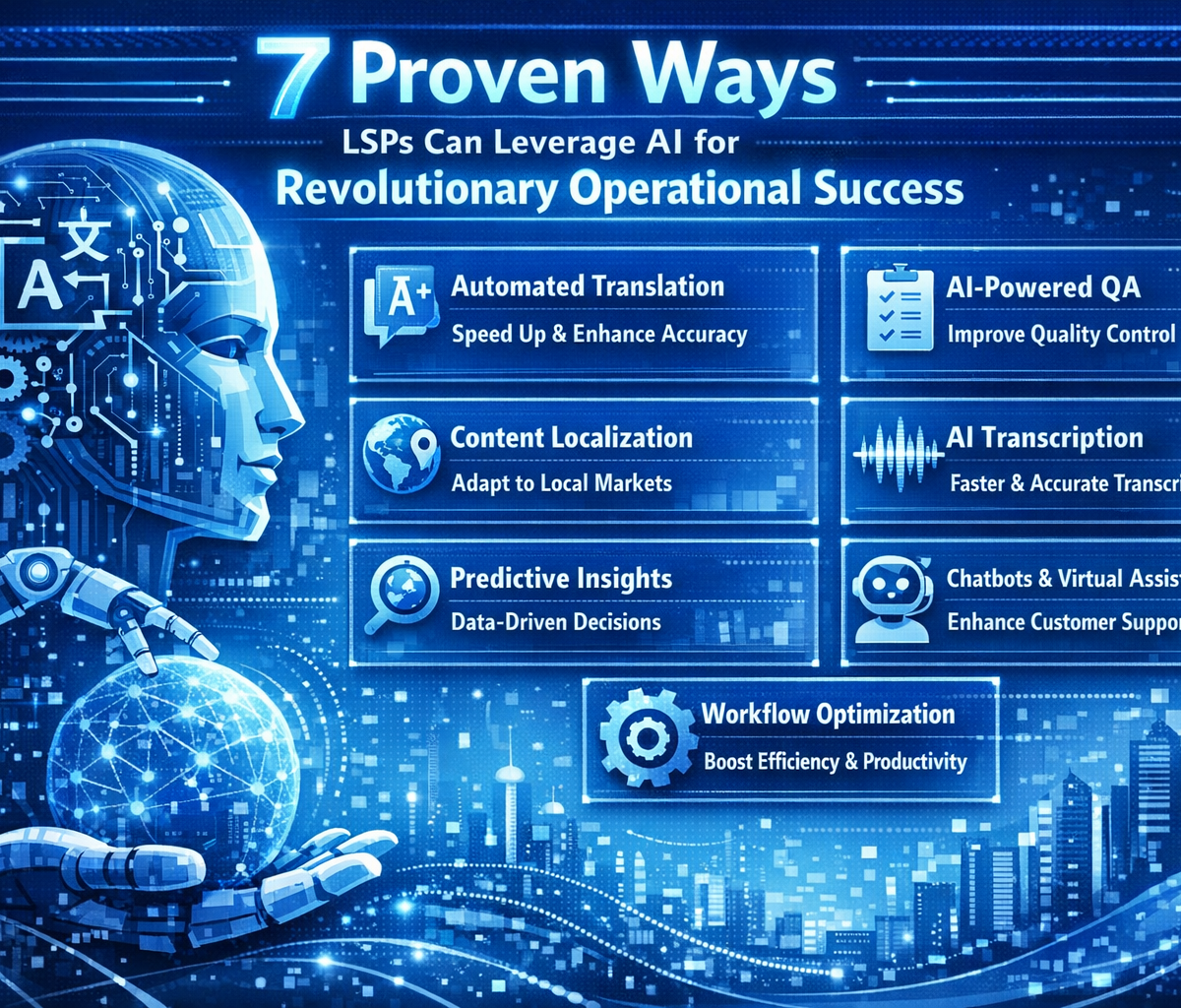
Beyond mere translation: ways LSPs can leverage AI to revolutionize their operations.
In the era of AI, discussions regarding language service providers (LSPs) primarily center on translation and content creation, which is quite reasonable. However, there’s an additional aspect of the business that is equally ready for innovation: operations. From workflow overloads to monotonous manual activities, LSPs encounter daily inefficiencies that consume time and resources. The positive announcement? Strategic AI integration is transforming that, without requiring a complete tech team.
Our Innovation Lab serves as tangible evidence. Created by a compact, mixed team, it offers AI-driven solutions that lower expenses, minimize mistakes, and provide teams with precious hours back each week. The twist? The majority of the automation doesn’t affect the linguistic aspect whatsoever.
Let’s examine how this functions in reality
The concealed capabilities of non-linguistic AI for LSPs
Non-linguistic activities are an ideal application for AI in LSPs. Consider all the repetitive, rule-oriented tasks: following up on invoices, counting words from scanned PDFs, extracting text from handwriting, or sending annual tax documents. These may not be fancy, but they accumulate quickly.
These workflows typically satisfy three important criteria: they are executed frequently (occasionally hundreds of times each month), they don’t need extensive expertise, and they generally adhere to consistent rules. AI flourishes in such environments.
Even more impressive? Automating these tasks provides immediate, quantifiable ROI and typically encounters significantly less opposition than AI in language-related processes. There’s no anxiety about losing jobs, no worries about brand voice. Only time saved and mistakes prevented.
Due to the usual separation of these tasks among PMs, sales, and finance, automation serves as a means to link internal teams, enhance communication, and optimize processes across various departments.
Two Strategic Methods for Implementing AI in Workflows
Two methods for implementing AI
In practical terms, we have recognized two separate models for utilizing AI in operational automation:
AI as a vital operational element – where AI is essential to the solution, the tool cannot operate without it.
AI as a creator – in this case, we utilize AI to assist us in crafting solutions, but the end result does not depend on AI whatsoever.
In either scenario, LSPs can operate more quickly, intelligently, and with little additional cost
Examples of applications that produce tangible outcomes
Word counts from image files: Clients frequently submit scanned documents for estimates. The common choices are either hiring DTP (costly and time-consuming) or manual assessment (unstable and imprecise). AI-driven OCR automates the whole procedure. Outcomes are swift, dependable, and cost under 1 cent for each page.
Real-World Success: Tangible Results from AI Integration

Transcribing handwritten records: Legal, medical, or governmental forms are frequently written by hand or marked with stamps. Conventional OCR struggles in this situation. We developed a system that employs AI to capture not just handwriting but also stamps, seals, and even table configurations. Precision is elevated, and expenses have decreased by 70%.
Automated invoice reminders: The finance department previously dedicated 6–8 hours each month to manually dispatch payment reminders — checking Excel files, locating PDFs, and composing emails. Currently, a Python application accomplishes everything in less than 15 minutes, even creating bilingual messages based on the client’s language.
Distribution of vendor tax forms: Annually, the finance team was required to divide a 500+ page PDF into more than 200 customized documents, sign every file, and send them via email. It is now a completely automated process: from dividing and renaming to sending emails. What previously required 3–4 days now only takes 15 minutes.
These aren’t just hypothetical benefits; they are integral to Creative Words’ monthly schedule.
A tech team isn’t necessary for this task.
A key takeaway from our experience is this: a significant portion of the automation was created by ex-linguists. Thanks to fundamental Python training and GenAI’s assistance, individuals with no technical experience are now creating automations that aid sales, project management, and finance.
Building an Innovation Lab Without a Massive AI Tech Team
The Innovation Lab functions with a team of only four individuals: a Workflow Automation Engineer, two AI Language Specialists (previously linguists), and an Innovation Leader. Out of 4 team members, only 1 (the Workflow Automation Engineer) possesses a conventional technical background. Concluding reflections
Strategic AI focuses on enhancing human roles rather than displacing them or initiating large-scale transformation initiatives. It’s focused on addressing the issues you currently face — more quickly, at a lower cost, and with the assets you already possess.
LSPs should not worry about AI. They must begin to utilize it, and ROI prospects for LSPs extend beyond translation to the operational processes that take up a considerable portion of your team’s time