
Table of Contents
Translation is often described as the art of transferring meaning from one language to another. While that definition sounds simple, the reality is far more complex. An accurate and accepted translation is not merely a word-for-word conversion of text. It is a carefully crafted communication that preserves meaning, intent, tone, context, and cultural relevance. In today’s globalized world, businesses, governments, educational institutions, and individuals depend on high-quality translations to communicate effectively across borders. A single mistranslation can lead to misunderstandings, legal complications, financial losses, or damage to a brand’s reputation.
The demand for professional translation services continues to grow as companies expand into international markets and digital content becomes accessible worldwide. Readers and customers expect translated content to feel natural, trustworthy, and easy to understand. This expectation has raised the standards for what constitutes an accepted translation. Translation quality is now evaluated through a combination of linguistic precision, cultural sensitivity, industry expertise, and quality assurance procedures.
International standards such as ISO 17100 emphasize qualified translators, independent revision, project management, and quality verification as essential components of professional translation services. These requirements help ensure that translations meet both client expectations and industry benchmarks.
Understanding the Meaning of Accurate Translation
Accuracy vs. Literal Translation
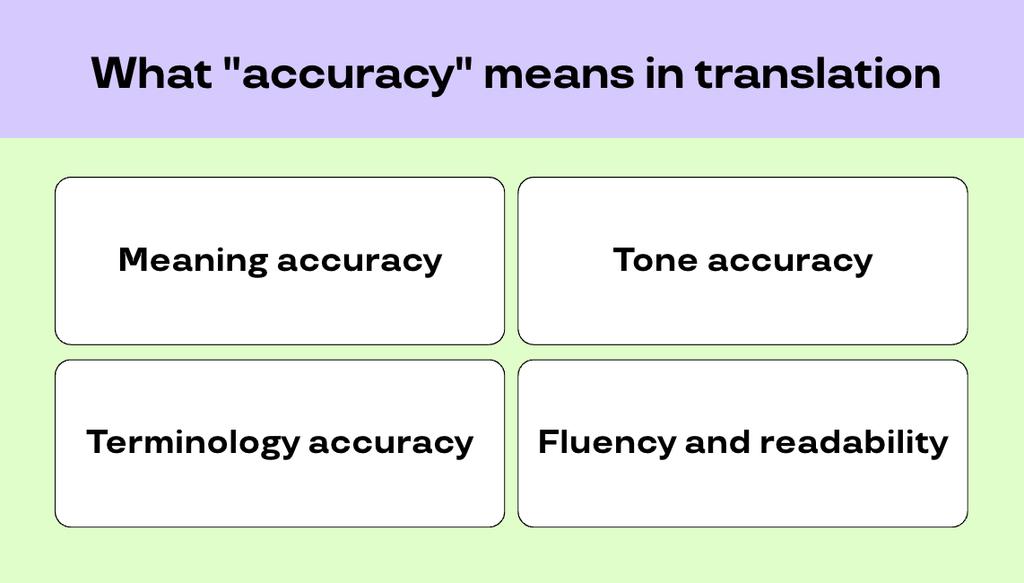
Many people mistakenly assume that accuracy means translating every word exactly as it appears in the source text. In reality, literal translation often creates awkward, confusing, or even misleading results. Languages differ in structure, idioms, cultural references, and stylistic conventions. A translation that focuses solely on matching words may fail to communicate the intended message.
Accurate translation is about preserving meaning rather than preserving individual words. Imagine translation as rebuilding a house using local materials in a different country. The appearance may change slightly, but the structure, purpose, and functionality remain intact. Skilled translators understand how to adapt expressions, sentence structures, and cultural references while maintaining the original intent.
The best translations often feel as though they were originally written in the target language. Readers should not struggle to interpret awkward phrases or unnatural wording. Instead, they should experience clear, fluent communication that accurately reflects the source content.
Why Accuracy Matters in Global Communication
Accuracy forms the foundation of trust. Whether translating a legal contract, medical report, marketing campaign, or technical manual, every detail matters. A small error can alter meaning significantly. In legal and regulatory contexts, inaccurate translations may result in compliance issues or disputes. In healthcare, mistranslations can affect patient safety. In business, unclear messaging can weaken customer confidence.
As organizations increasingly operate across multiple languages, translation accuracy has become a strategic asset rather than a simple linguistic service. Companies that invest in quality translation gain credibility, strengthen customer relationships, and reduce communication risks.
What Makes a Translation Accepted?
Industry Expectations
An accepted translation is one that satisfies the expectations of both the client and the intended audience. Acceptance depends on the purpose of the translation. For example, a legal document requires strict precision and formal terminology, while a marketing campaign demands creativity and cultural adaptation.
Industry-specific requirements often determine whether a translation will be considered acceptable. Technical industries require consistent terminology. Healthcare organizations need clarity and accuracy. Financial institutions expect compliance with regulatory language. Understanding these expectations is essential for delivering successful translations.
Client and Audience Requirements
Translation quality is not measured solely by linguistic accuracy. The target audience must also understand and connect with the message. A technically correct translation may still fail if it sounds unnatural or culturally inappropriate.
Successful translators analyze the audience’s language preferences, cultural background, education level, and communication style. This audience-centered approach ensures that translated content resonates effectively while maintaining its original purpose.
The Core Specifications of Accurate Translation
Linguistic Accuracy
Linguistic accuracy is the most obvious requirement of quality translation. Every sentence must convey the intended meaning without omissions, additions, or distortions. Translators must understand both the source and target languages deeply, including grammar, syntax, vocabulary, and stylistic conventions.
Accuracy extends beyond vocabulary selection. It requires careful interpretation of context, tone, and nuance. Words often have multiple meanings, and choosing the wrong interpretation can dramatically alter a message.
Terminology Consistency
Consistency is especially important in specialized fields such as medicine, law, engineering, and finance. Technical terms must be translated uniformly throughout a document. Inconsistent terminology can confuse readers and reduce credibility.
Many professional translators use terminology databases and translation memory tools to maintain consistency across large projects. These tools support quality control while ensuring alignment with client preferences and industry standards.
Grammatical Correctness
Grammar errors immediately reduce the perceived quality of a translation. Readers often associate poor grammar with a lack of professionalism and reliability. An accepted translation must follow the grammatical rules of the target language while maintaining natural readability.
Grammatical correctness includes proper sentence structure, punctuation, verb agreement, and word order. Even minor mistakes can distract readers and weaken the effectiveness of communication.
Contextual Relevance
Words rarely exist in isolation. Context determines meaning. Accurate translation requires understanding the broader message, purpose, and circumstances surrounding the text. Translators must evaluate how specific terms function within the overall content rather than translating them independently.
This contextual awareness helps prevent misunderstandings and ensures that the final translation accurately reflects the original message.
Cultural Adaptation as a Quality Requirement
Understanding Cultural Nuances
Language and culture are inseparable. Every language reflects the values, traditions, and communication styles of its speakers. Translators who ignore cultural context risk producing content that feels unnatural or inappropriate.
Cultural adaptation involves adjusting references, idioms, examples, humor, and communication styles to suit the target audience. This process helps readers connect with the message while preserving its original purpose.
Research continues to highlight the importance of balancing linguistic fluency with cultural fidelity, particularly when translating socially meaningful content.
Avoiding Cultural Misunderstandings
Cultural misunderstandings can have serious consequences. A phrase that is harmless in one culture may be confusing or offensive in another. Effective translators recognize these differences and adapt content accordingly.
Successful localization goes beyond language. It ensures that every element of communication aligns with the expectations and values of the target audience. This cultural intelligence is one of the defining characteristics of accepted translation.
Industry Standards for Translation Quality
ISO 17100 Requirements
One of the most recognized standards in the translation industry is ISO 17100. This international standard establishes requirements for translation services, including translator qualifications, project management procedures, revision processes, and quality assurance measures. Rather than focusing solely on the final translation, it emphasizes the entire workflow required to achieve consistent quality.
According to ISO 17100, translation projects should involve qualified professionals, independent revision by a second linguist, and documented quality control procedures. These measures reduce the likelihood of errors and improve overall reliability.
| Quality Element | Importance |
|---|---|
| Qualified Translators | Ensures linguistic competence |
| Independent Revision | Detects errors and inconsistencies |
| Project Management | Maintains workflow efficiency |
| Quality Verification | Confirms final accuracy |
| Documentation | Provides accountability and traceability |
Quality Assurance Processes
Professional translation agencies implement multiple layers of quality assurance. These typically include translation, self-review, independent revision, proofreading, and final verification. This systematic approach significantly improves accuracy and consistency.
Quality assurance is not an optional extra. It is a critical component of accepted translation and one of the primary factors that distinguish professional services from basic machine-generated output.
The Role of Professional Translators
Subject-Matter Expertise
Language skills alone are not enough. Professional translators often specialize in specific industries. A legal translator understands legal terminology and procedures. A medical translator understands healthcare concepts and regulatory requirements. This subject-matter expertise enables accurate interpretation of complex content.
Industry knowledge reduces ambiguity and improves the translator’s ability to make informed linguistic decisions. It also increases confidence among clients who require precise communication.
Continuous Learning and Research
Languages evolve constantly. New terminology, technologies, and communication trends emerge every year. Professional translators stay informed through ongoing education, industry research, and professional development.
This commitment to learning helps translators maintain high standards and adapt to changing market demands. It also supports their ability to handle emerging topics and specialized content effectively.
Common Causes of Poor Translation
Over-Reliance on Machine Translation
Artificial intelligence and machine translation tools have transformed the language industry. They provide speed and convenience, especially for large volumes of content. However, machine-generated translations often struggle with context, cultural nuances, humor, and specialized terminology.
Without professional review, machine translation can produce inaccurate or unnatural results. Organizations that rely exclusively on automated tools may compromise quality and credibility.
Lack of Context
Many translation errors occur because translators receive insufficient information about the source content. Missing context can lead to incorrect word choices and misunderstandings.
Providing reference materials, style guides, glossaries, and background information helps translators make accurate decisions. Context is not a luxury; it is a necessity for quality translation.
How to Evaluate Translation Quality
Accuracy Checks
Evaluating translation quality involves comparing the source and target texts to verify meaning, completeness, and consistency. Reviewers assess terminology usage, contextual accuracy, and linguistic correctness.
Professional evaluations often use structured quality metrics that identify errors and measure overall performance. These assessments help organizations maintain high standards across multilingual content.
Revision and Proofreading
Revision and proofreading are separate but equally important stages. Revision focuses on accuracy and consistency, while proofreading addresses grammar, punctuation, formatting, and readability.
Independent revision is widely recognized as one of the most effective methods for improving translation quality and reducing risk. Professional workflows incorporate multiple review stages to ensure excellence.
The Future of Accurate Translation
The future of translation lies in collaboration between human expertise and advanced technology. Artificial intelligence will continue to improve productivity, terminology management, and quality assurance. Human translators will remain essential for handling context, creativity, cultural adaptation, and complex communication challenges.
Businesses increasingly expect translations that are not only accurate but also culturally relevant, audience-focused, and strategically aligned with brand objectives. As global communication becomes more interconnected, quality standards will continue to rise.
Translation is no longer viewed as a simple support function. It has become a critical component of international growth, customer engagement, and organizational success. Companies that prioritize translation quality will be better positioned to build trust and compete in diverse markets.
Conclusion

Accurate and accepted translation requires far more than bilingual ability. It demands linguistic precision, contextual understanding, cultural awareness, industry expertise, and rigorous quality assurance. International standards such as ISO 17100 reinforce the importance of structured workflows, qualified professionals, and independent review processes. Together, these elements create translations that are trustworthy, effective, and suitable for their intended purpose.
As organizations continue expanding across borders, the value of professional translation will only increase. Investing in quality translation protects brand reputation, strengthens communication, and creates meaningful connections with audiences around the world. The specifications of accurate and accepted translation are not simply technical requirements—they are the foundation of successful global communication.
Frequently Asked Questions
1. What is the most important characteristic of an accurate translation?
The most important characteristic is the accurate transfer of meaning from the source language to the target language without distortion, omission, or misunderstanding.
2. Why is cultural adaptation important in translation?
Cultural adaptation ensures that translated content feels natural, relevant, and appropriate for the target audience while preserving the original message.
3. What is ISO 17100?
ISO 17100 is an international standard that defines requirements for professional translation services, including translator qualifications, revision procedures, and quality management processes.
4. Can machine translation replace human translators?
Machine translation can improve efficiency, but human translators remain essential for context interpretation, cultural adaptation, and quality assurance.
5. How can businesses ensure translation quality?
Businesses should work with qualified translators, provide context and reference materials, use consistent terminology, and implement independent review and proofreading processes.